


I'll be the first to admit, journalists in Britain are a nuisance. Our pursuit of the truth can be obsessive, our methods and execution abrasive. "Can you soften the language?" was the constant refrain I'd get from No10 every time I asked for a right of reply.
The current media landscape leaves much to be desired, too. Westminster hacks seem to care more about having a skinful with staffers down the Westminster Arms than holding MPs to account, and I’m not overly enthused about stuffing media organisations with former and current politicians.
The public interest defence is also doing a lot of heavy lifting when a celebrity’s dating history is dredged up in the wake of their death.
And yet, despite these shortcomings, I’m thankful that I live in Britain, not Russia, where merely calling Vladimir Putin’s illegal invasion of Ukraine a “war” can result in a 15-year prison sentence, a life in exile or even murder, and all independent media organisations have been banned.
It would seem that a growing number of politicians, high-profile commentators, and even fellow journalists violently disagree. They appear to relish Britain becoming an autocracy.
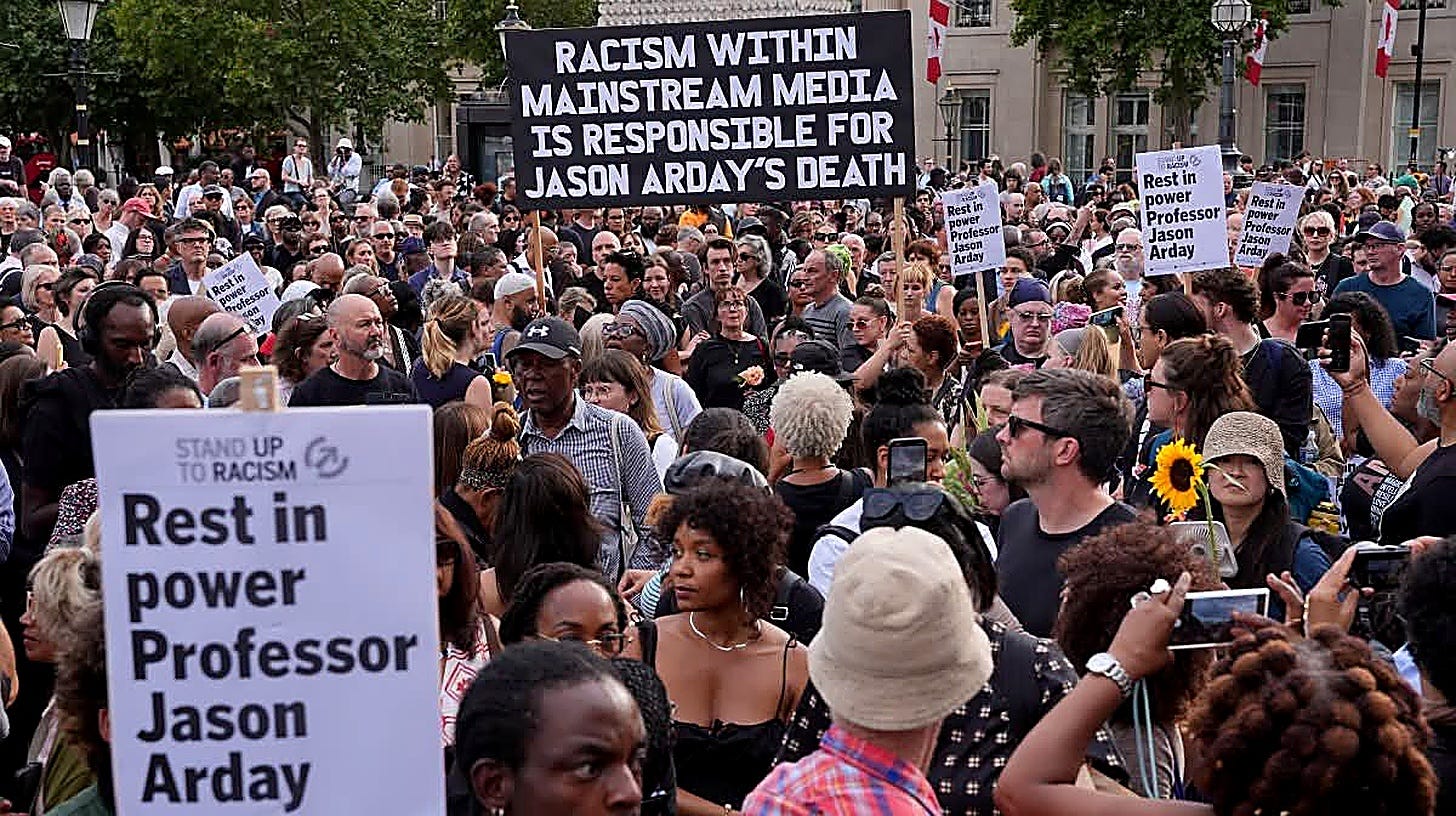
I’ve reached this disturbing conclusion after carefully weighing the response to the tragic death of Jason Arday, the former University of Cambridge professor at the centre of a plagiarism row, who was found unresponsive in his London home on Friday.
Green Party leader Zack Polanski and actress Jameela Jamil are among the 90,000 signatories to a petition calling for an “immediate public inquiry into how to ensure a responsible press”.
The letter, issued by the Good Law Project, which had been representing Arday after he stood down from his Cambridge role, noted that many of its signatories had warned several media outlets that the “relentless pursuit of Dr Arday risked his suicide”.
One notable signatory, Lord Woolley, principal of Homerton College at Cambridge, said Arday had been subjected to a “vicious witch hunt”. Left-wing commentator Narinder Kaur decried the “racist media” for killing Arday and called for a “Leveson 2” – presumably to muzzle the press. Marina Purkiss, the other go-to leftie, was incandescent with rage as she told Jeremy Vine that the sheer volume of articles written about Arday amounted to a “bloodsport”.
The writer Matt Haig urged Andy Burnham to change the law so journalists face “consequences” for what he calls a “politically motivated campaign” (I call rigorous reporting).
Then there’s the nasty campaign to discredit Nathan Cofnas, the journalist who broke the story about Arday. The hurty words brigade have called him every defamatory name under the sun, from a “eugenicist” to a “white Jewish supremacist”. One user on X made his doxxing explicit, announcing that he was starting a “witch-hunt” against Cofnas with his post. The accused made the point that he probably would have been murdered if he were in London the night throngs of activists attended a vigil for Arday.
Likening these attacks on the media to flirting with tyranny will strike some as unfounded hyperbole and even self-serving coming from a hack - these are just basic appeals to human decency, right? Think again.
Press freedom is a sliding scale and its retreat is barely noticeable at first. But the environment can soon change. And powerful interests are increasingly looking for pretexts to crack down on those asking too many questions.
According to the watchdog RSF (Reporters Without Borders), global press freedom has hit a 25-year low. Over half of the world’s countries now fall into “difficult” or “very serious” categories as hostile political attacks, economic pressures, and expansion of legal weapons make the environment in which independent media operate increasingly challenging.
This decline is sharpest not in countries that have long been ruled by strongmen but in ostensible democracies – a profoundly chilling development because, as The Economist has shown, graft rises as press freedom falls.
This negative feedback loop extends to trust in the media. The more politicians are scrutinised for their actions, the more likely they are to frame journalists as part of “the establishment” out to get them and sow public distrust.
The rise of social media has made their jobs infinitely easier. When the likes of Alastair Campbell go after the ‘right-wing press’ for creating the conditions that led to Arday’s death, pay close attention to who likes and retweets these posts.
Blaming the mean old media also wilfully ignores the hard truth behind the whole tragedy: an obsession with race has left two children without a father. A system built on sand propelled him into the ivory tower because no one interrogated his claims. Living a lie ultimately consumed him.
It exposes the ugly myth at the heart of identity politics: that an immutable characteristic affords a person special insight. The truth is, knowledge is knowledge: it doesn't change when refracted through the prism of race, gender or sexuality.
This argument would land differently coming from any number of black intellectuals and journalists I hugely respect, but that’s again missing the point. We need to break out of this straitjacket that insists identity matters in the pursuit of excellence.
The outraged social justice warriors who organised Arday's vigil, weren't outraged at all when Henry Nowak's demise was made public … I wonder why ?🤔
Where is the vigil for the wonderful Ann Widdecombe ? This country is broken.