



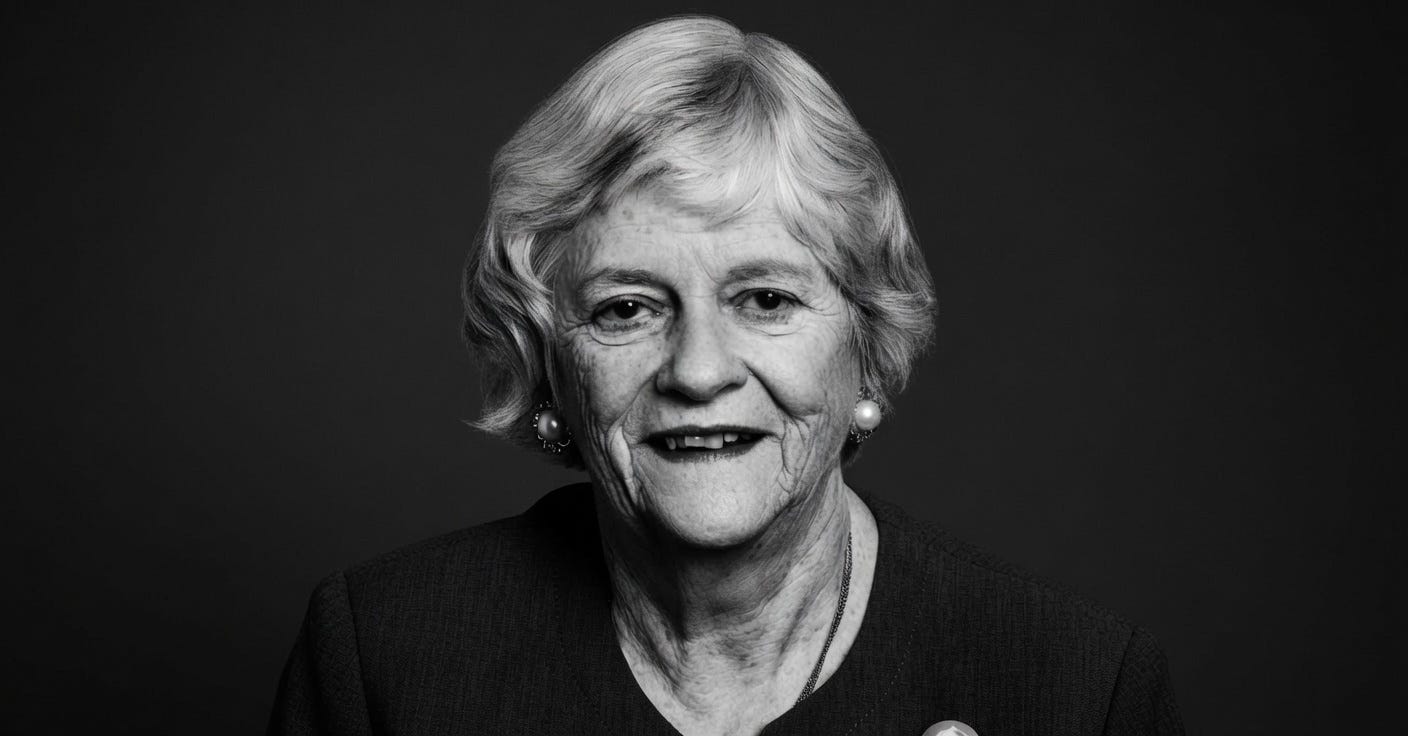
The old adage, ‘When America sneezes, Britain catches a cold’, has always felt more like a self-fulfilling prophecy than a statement of fact. For that reason, I tend to resist making transatlantic comparisons wherever possible.
However, the parallels between the left’s response to the murder of Charlie Kirk on a Utah campus and Ann Widdecombe’s murder in her Dartmoor home are impossible to ignore once you see them.
I will not speculate about Widdecombe’s case while the investigation is still ongoing. I will say, however, that Devon and Cornwall Police have delivered a masterclass in miscommunication: initially saying there was “nothing to suggest” the killing was politically motivated or linked to terrorism, before rearresting a 28-year-old suspect under the Terrorism Act the following day and later confirming that Widdecombe had been killed in a “targeted attack”. In an attempt to reassure the public and prevent speculation, the police appear to have achieved the exact opposite. They would have been much wiser to say nothing at all.
What I will call out is how quickly sections of the left jeered at a woman I regarded as both a friend and a colleague. The frenzied delight they took in the death of an old lady transported me back to the day the MAGA influencer Charlie Kirk was murdered.
Some people will balk at this comparison. "It’s crass, inappropriate, too soon," they will say. And granted, it’s not perfect: Kirk was American, Ann was British; both were at very different stages of their lives and political careers. There was, too, some distance between Widdecombe and Kirk on Donald Trump. The former criticised Trump’s refusal to commit to a peaceful transfer of power in 2020 and was unimpressed by his unedifying comments about the Pope earlier this year, among other things.
But in many ways, Widdecombe and Kirk were cut from the same cloth. Both had moral and political convictions deeply rooted in their Christian faith, which informed their thinking on a wide range of issues such as abortion and same-sex marriage.
Both were alarmed by the decline of Christianity in the West and what they saw as a moral vacuum that was being increasingly filled by secular progressivism and the growing influence of Islam.
Above all else, Widdecombe and Kirk were fearless champions of free speech. They were strident in their views but unafraid to have them challenged, recognising that the best ideas ultimately prevail.
To this end, Kirk would robustly debate his left-wing opponents on university campuses across America. Likewise, Widdecombe would thrash it out in Britain’s once-venerable academic institutions (her unscripted Oxford Union speech opposing the motion “We Should Support No Platforming” is legendary).
These qualities put them both on a collision course with the #BeKind crowd, who are better described as #censorious, #thin-skinned and #vengeful. On 27 November 2016, Kirk tweeted an observation that would prove prophetic: “You can tell a lot about a person by how they react when someone dies.”
Barely a nanosecond after the bullet struck Kirk’s neck, social media was flooded with videos of blue-haired lunatics jumping up and down with joy.
One user wrote: “I feel bad for the bullet”, while another declared: “Finally some good news. The killer stopped a Nazi.” This wasn’t just mollycoddled self-ID freaks furiously hitting their keyboards, but prominent left-wing columnists too.
In the immediate aftermath of Kirk’s assassination, Washington Post columnist Karen Attiah wrote on social media that she “refused to tear my clothes and smear ashes on my face in performative mourning for a white man that espoused violence is... not the same as violence”. She was later fired by the newspaper over her comments.
The speed with which this same crowd danced on Widdecombe’s grave last week was enough to induce whiplash.
The news had barely broken before social media descended into a cesspit of hate and sanctimony. “Good riddance,” one user wrote, while another posted: “Ding Dong the Witch is Dead.”
Peter Tatchell led the baying mob by reeling off Ann’s rap sheet, which included her opposition to same-sex marriage, and calling her a “BIGOT”. He later deleted the tweet and apologised after the police confirmed they had launched a murder investigation into her death.
The Socialist Worker ran with the more sensitive headline, “Hurrah! Ann Widdecombe is strictly dead”, before deleting it after a severe backlash. Then there is Heather Herbert, a transgender employee of Aberdeen University and former Labour candidate, who is currently being investigated by the police after wishing Widdecombe suffered an “extremely painful death” while “handcuffed to the bed as she screamed in agony”.
The torrent of hate directed at a woman who, throughout her life, carried herself with the utmost dignity and extended that same dignity to even her fiercest critics, sickened me to the core.
It reminded me of an observation the late Conservative philosopher Roger Scruton made during an interview in which he said: “Leftwing people find it very hard to get on with rightwing people, because they believe that they are evil. Whereas I have no problem getting on with leftwing people, because I simply believe that they are mistaken.”
The attacks also completely misrepresented who Widdecombe was. She wasn’t in the least bit bigoted. Yes, she held views that were unfashionable in the modern era - a deeply held religious belief will do that. But she was also a social conservative who would update her views when necessary.
I have a personal anecdote that supports this. During my stint as opinion editor at GB News, Widdecombe would write a weekly column for me. We would speak on the phone every Monday to discuss the latest political developments that week and I’d give her a steer on what to write about.
Occasionally, the story would write itself. This was certainly the case last August when, speaking to the Times, Vanessa Frake, former prison governor and Reform’s newly appointed UK justice adviser, said that trans women should not automatically be removed from women’s prisons. This caused an uproar among Reform supporters, who feared their new political home had already become infected with wokeism.
Before Reform clarified its position, I asked Widdecombe, a former Prisons Minister in John Major’s Conservative government and spokesperson for Nigel Farage’s party, to offer her own views on the subject.
In her column that week, she wrote: “There is a very small number of trans people who have gone the whole hog. They look and sound exactly like the women they believe they have become, and they may have lived that way for years.
“We have a duty to ensure their safety too, and beyond all peradventure, they would not be safe in a male prison but liable to serious sexual assault.”
Her remarks whipped up a storm on both sides of the political divide, with Labour MP Jonathan Hinder even calling her “woke”.
But her position will not come as a surprise to anyone who knew Widdecombe well or had followed her career closely. Anyone who had will tell you she reasoned her way through any given situation and did not show blind allegiance to a tribe. In other words, a true contrarian.
Brilliant piece.
The Radical Left have lost decency in compassion
We are truly living in a they them and us society
Were depending on your views you are either welcomed or chastised and battle lines are the new normal on either side that aren't to be crossed or challenged