


It’s a bad time for British academia. The University of Cambridge faces a credibility crisis after its faculty was taken in by what appears to be a serial fantasist.
The plagiarism allegations dogging Jason Arday, until recently the youngest Black professor ever to walk these hallowed halls, expose the extent to which woke ideology has corrupted Cambridge’s hiring practices.
Is intellectualism merely an affectation? How could these academics be so incurious? Is equality of opportunity now secondary to identity and victimhood? Unsettling questions abound.
The outrage is, therefore, understandable. That being said, the Arday affair was not the most chilling revelation to emerge from Britain’s elite institutions last week.
The Oxford Union finally released its debate on Islam following months of pressure, which, before it got drowned out by the Arday affair, exposed the religion’s influence on polite British society.
The particular moment I’m referring to was made all the more shocking because it was antithetical to the Union’s core value: the right to express one’s opinions freely and have them challenged.
This is the same debating society that likes to impress upon you just how much it values free speech.
Sitting proudly on its website is Harold Macmillan’s proclamation that the debating society, which was founded in 1823, is “the last bastion of free speech in the Western world”.
The quote’s attribution reads, or rather shouts: ‘PRIME MINISTER OF THE UNITED KINGDOM 1957-63, LIBRARIAN OF THE UNION, 1914’, underscoring the point that freedom of expression and the pursuit of knowledge are the central pillars upon which human greatness rests.
The Union’s commitment to free speech has been no stranger to controversy throughout its 200-odd-year history, not least because it has tended only to reflect the views of a cossetted and craven elite.
The most infamous example of this was in 1933, when students voted 275 to 153 to pass the infamous motion, “That this House will under no circumstances fight for its King and Country”.
The resolution ignited a national firestorm, with Winston Churchill going as far as to say that Adolf Hitler would draw the conclusion that Britain had lost the moral courage to fight his aggression.
The charge that the Union is stacked with progressive appeasers is therefore nothing new, but it hit a new low this year, when leaked WhatsApp messages revealed that its president Arwa Elrayess described Hamas’s murderous assault on Israel on 7 October 2023 as “proportional” and said that groups branded as terrorists were often later “lauded as heroes” in a student group chat (she said the allegations made against her were “categorically untrue” and that her comments had been taken out of context).
Let’s also not forget that her appointment followed George Abaraonye, the previous president-elect, who was ousted for celebrating the death of Charlie Kirk (he posted a message on Instagram which read “Charlie Kirk got shot loool”).
As odious as I find their positions, I defend their right to hold them. As the great novelist Salman Rushdie once famously said: “What is freedom of expression? Without the freedom to offend, it ceases to exist.”
I find it sanity-restoring, then, that in the spirit of free speech, Elrayess - the Union’s first Palestinian president - invited Tommy Robinson to debate the motion “This House believes the West is right to be suspicious of Islam”.
More admirable still is that she faced a barrage of hate for doing so and defended her decision in an article in The Telegraph.
You can imagine my disappointment, then, that Elrayess and the other speakers opposing the motion were all too willing to renege on their commitment to free speech for fear of offending Muslims.
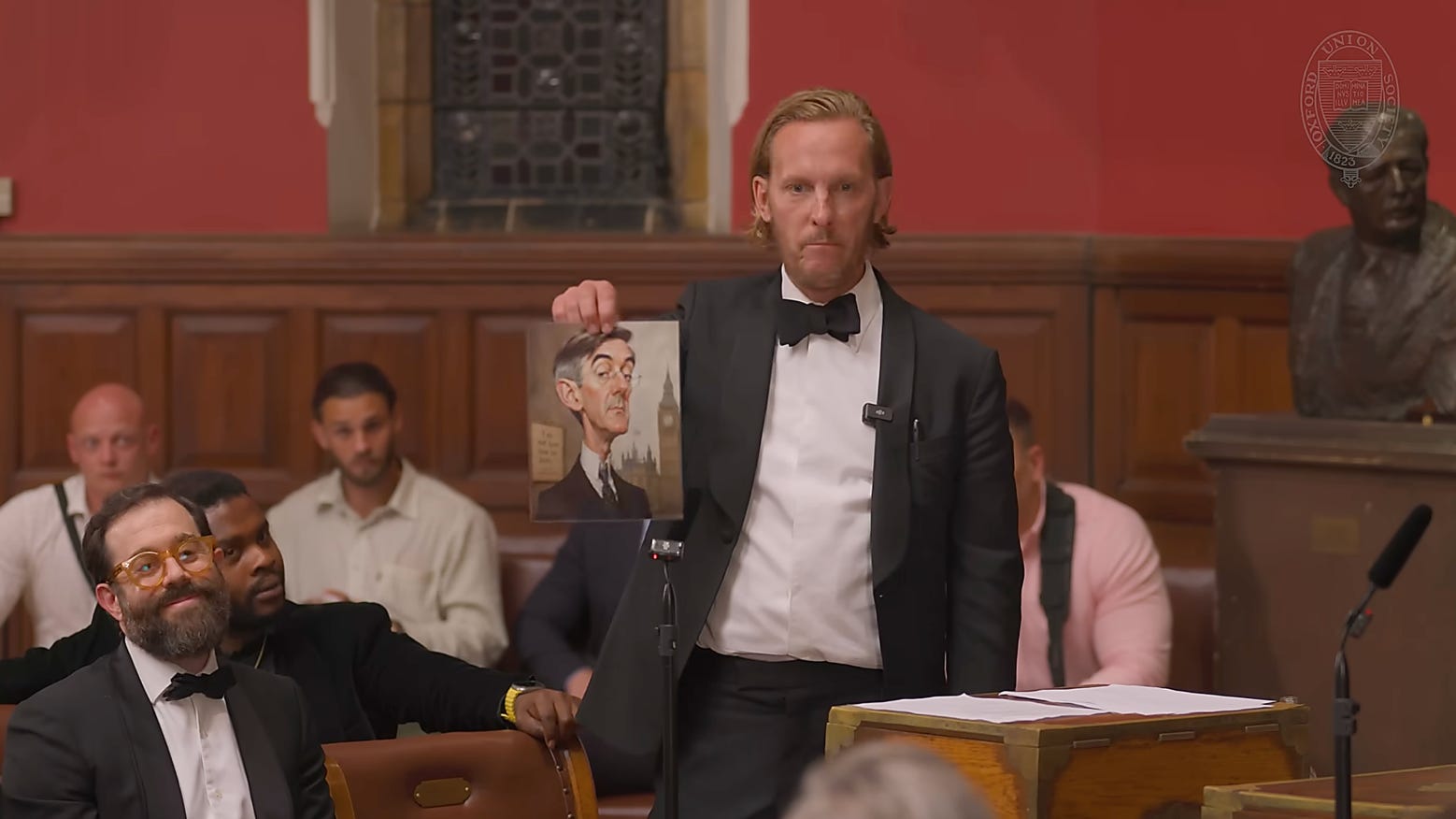
I’m referring to the moment the Chamber descended into chaos after Laurence Fox, who was arguing in favour of the motion, brandished an envelope purportedly containing a cartoon picture of Muhammad.
You can feel the temperature rising in the room as Fox says the cartoon picture in his envelope “instills in me feelings much more worrying than suspicion” and “My wife asked me not to show this for fear of repercussions for my family” but “I will not be commanded to love or submit to ideas or ideologies”.
That same president who’d shown a rare flash of bravery leading up to the debate suddenly leapt out of her chair in a skittish state and attempted to cut the speaker off.
“Is it not enough that half the team that invited you to this debate were Muslim women who wanted to hear your expression and your arguments? Is it not enough that I, as a Muslim president, have invited you to this Chamber to give your arguments? Is it not enough justification and evidence for you to believe that we do believe in free speech?,” she bleated.
Even Jacob Rees-Mogg, who, like Macmillan before him, was elected Librarian of the Oxford Union, joined the rising chorus, asking whether the ban on using props in the House of Commons extends to the Union in a desperate attempt to stall Fox.
His ploy was ultimately dismissed after a point of order ruled that there’s no ban on using props in the House and a young chap in the audience rather brilliantly made the point that no such prohibition was applied to PLO flags that had been flown in previous debates.
Yet when it came to the grand reveal, a collective terror paralysed the debating chamber. It was as if Fox was about to utter Voldemort’s name and activate the curse that summons the Death Eaters.
Instead, he opened the envelope and unveiled a cartoon picture of Rees-Mogg. It was a stroke of comedic genius that proved his point entirely and, to my mind, instantly won the debate.
The nervous reaction was no laughing matter, however, and there are serious lessons that need to be drawn from it.
I’m not saying the collective hysteria wasn’t understandable. From armed Islamists storming the satirical newspaper Charlie Hebdo and murdering 12 people to the beheading of the French teacher Samuel Paty and the Batley schoolteacher who, at the time of writing, is still in hiding, the message is loud and clear: showing depictions of what Laurence Fox provocatively called the “very oversensitive sky wizard” can put your life in mortal danger.
“Oversensitive” being the optimal word. How can an open society founded on the ideas of the Enlightenment live cheek by jowl with a group of people who desire nothing more than to police thought and freedom of expression, and who are this combustible when you don’t comply?
Before the usual suspects pile in, I’m not saying most Muslims are Islamists - I draw all the necessary distinctions between moderate adherents of the faith and its radical arm.
I also acknowledge that there’s no way of knowing exactly what percentage of the two billion Muslims worldwide are sympathetic to extremists or are in fact extremists.
But there are some concerning data points. In 2006, as thousands gathered across the Muslim world to burn European embassies, issue threats and even take hostages in protest against 12 cartoons depicting the Prophet Muhammad published in a Danish newspaper, an Ipsos poll of British Muslims found that 62 per cent agreed that Muslims were right to be offended by the cartoons, while 22 per cent disagreed.
More concerning still, in a survey of 1,000 British Muslims undertaken for the BBC by the polling organisation ComRes in the aftermath of the Charlie Hebdo attack, four-fifths (78 per cent) of respondents found it ‘deeply offensive’ when the Prophet Mohamed was depicted in images, while almost one-third (32 per cent) of British Muslims said they were not surprised by the attacks on the magazine offices.
However, more than two-thirds of those polled said violence against the cartoonists and publishers behind the cartoons was unjustifiable. Almost all (95 per cent) described feeling loyal to Britain, while 93 per cent believed they should obey British laws.
Extrapolating the results of these surveys on a global level suggests there are potentially millions of Muslims who are to varying degrees sympathetic to the motives of terrorists, even if they wouldn’t carry out these attacks themselves. This presents a moral challenge to the West.
One theory as to why this religious intolerance has resisted modernity is that it has found strange bedfellows in the West. Attributing a mystical power to words and images is central to identity politics movements, or what their critics commonly refer to as the new religions.
Infantilising adults by treating them as too fragile to be exposed to certain words and images is a common tactic among identitarians and religious zealots alike. It’s a cunning way to shut down legitimate debate about untested and often dangerous ideas.
The rub is that human flourishing requires constant inquiry and error correction. Identity politics isn’t interested in either. Much better to hide behind protected characteristics and cancel anyone who questions them.
The most absurd example of this came in 2018, when Netflix’s top spokesman Jonathan Friedland was fired by the streaming giant after using the N-word during a PR meeting about sensitive language, where he was discussing why certain offensive words should not be used. Apparently, his good intentions counted for nothing. The mere utterance of the word made him disappear.
Whether it be Islam or anti-racism, no set of ideas or system of beliefs should go unchallenged. We desperately need the adults back in the room. The future of Western civilisation depends on it.
Many thanks for today’s missive. I watched the debate, but did not quite put it into perspaective as you’ve done—greatly expanding my understanding.
He sure hath-a-way with him that Laurence Fox. Also Jonathan Sacerdoti was brilliant !