



We often look to the past in search of meaning and morality in the present.
This act of remembering was not a single evolutionary breakthrough but the product of natural selection refined over hundreds of millions of years.
And with memory came knowledge. It taught our earliest ancestors, for example, not to touch fire directly but to preserve it. Logging these associations between specific objects and pain stimuli not only ensured our survival as a species but spurred innovation.
Trauma works in a similar way to memory - but can have the opposite effect. Children, for example, can inherit the effects of trauma through the way they are raised, sending them spiralling into addiction and damaging relationships.
Research has also found an association between severe trauma and changes in how certain genes are regulated, which in turn can influence stress responses, immune function, and susceptibility to psychiatric disorders. These processes are collectively referred to as generational, or intergenerational, trauma.
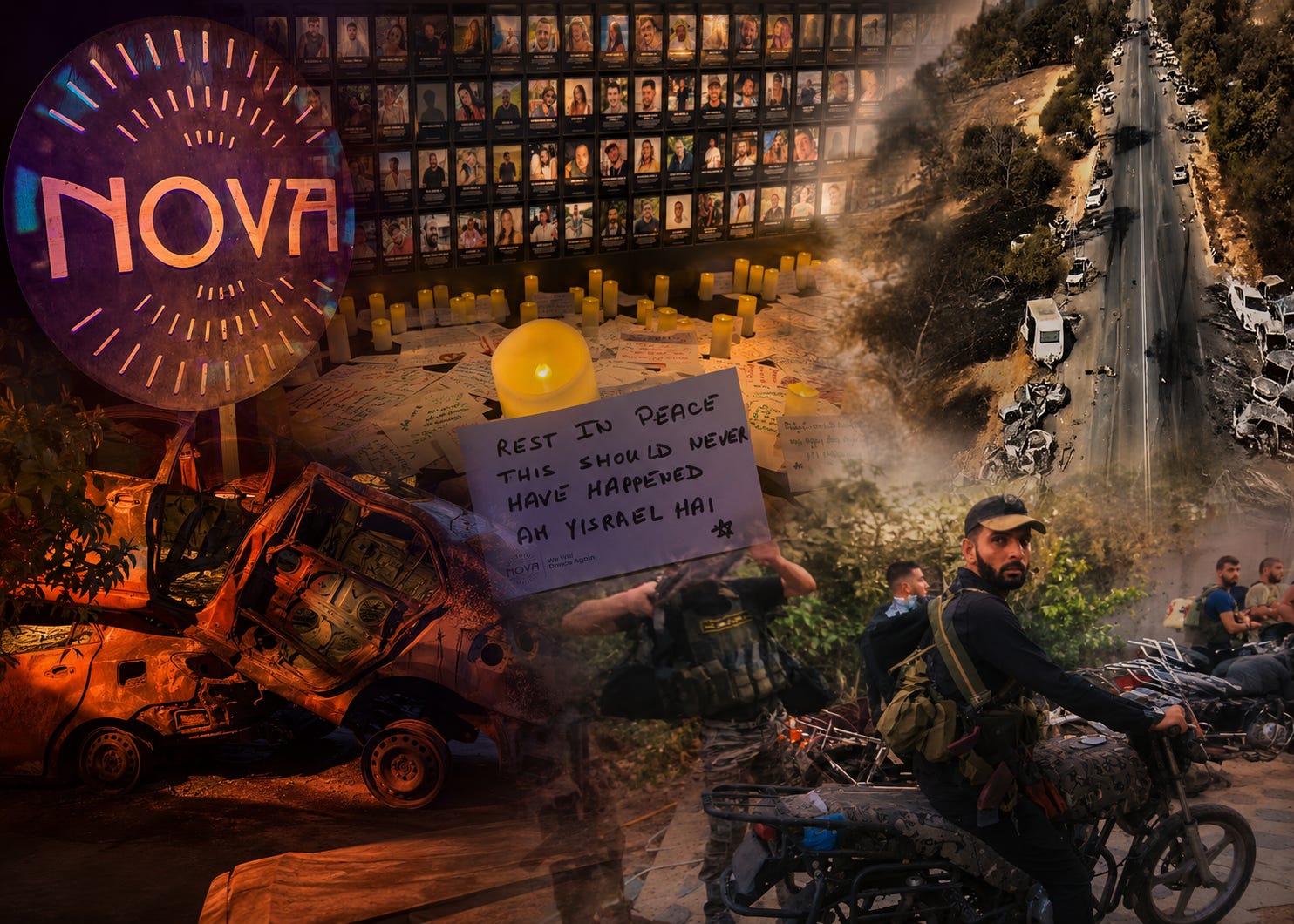
This relationship between the past and present is essential to understanding the Nova Exhibition, an immersive and at times agonising commemoration of the brutal massacre at the Nova Music Festival on October 7, 2023.
As I walked through the installation, two events from my past came flooding back. Both have shaped how I think about that atrocity and the war that followed, as well as the threat posed to Jews and the West more generally.
One important caveat: I approach this as a non-Jew, which affords me certain insights while limiting others. I am nonetheless someone who has formed a deep connection with the Jewish community.
Back to the events in question. A couple of years before Hamas launched its land, sea and air assault on Israel, the national newspaper I was working for at the time assigned me to cover March of the Living UK, a five-day educational programme in Poland that brings people from around the world together on Yom Hashoah, Holocaust Remembrance Day, to march along the railway tracks from Auschwitz to Birkenau, the largest Nazi concentration camp complex during the Second World War.
Although it’s open to people of all faiths and backgrounds and features diverse international delegations, the majority of participants are Jewish. Thousands of Jewish teenagers, adults and Holocaust survivors from dozens of countries attend the event.
I’ve always felt a gravitational pull towards Jewish people - one that I’m convinced my family tree will one day explain - but it was in these concentration camps that I truly understood both the specificity and universality of the Jewish experience. This may sound like a contradiction in terms, but it’s not. On the contrary, both ideas must be held in one’s mind simultaneously.
The specificity relates to the unique persecution of a minority group over more than two millennia, culminating in its most demented expression: the systematic, state-sponsored genocide of six million European Jews by the Nazi regime.
As my tour group was mainly composed of young Jewish adults, I bore witness to the intergenerational trauma wrought by those events. Watching them confront the inhumanity inflicted on their ancestors changed me forever.
I studied photographs and flickering projections of Jews who were their age before being herded into cattle cars without ventilation, food or water and transported to the death camps. In the faces of my tour group, I saw those who had been brutalised before them. At that moment, the distance between past and present collapsed.
How could this happen? Could I have done something to prevent it? A million questions swirled around my head.
I knew I needed to give the group space to grieve, but all I wanted to do was protect them. I had not thought much about the State of Israel before this trip, but it was in those moments that I realised the necessity of its creation.
As a journalist, you often find yourself facing ethical dilemmas. Should you remain an impartial observer? How close is too close to a subject? Such questions faded away as I sat with these young Jews, listened to their stories, and cried and laughed with them into the early hours of the morning.
I did not set out to forge lifelong friendships on a tour of Auschwitz. Yet after many birthdays, holidays and weddings together, that’s exactly what happened.
The trip also alerted me to universal truths about the human condition. The great Soviet author Vasily Grossman articulated this most powerfully in Life and Fate, writing: ‘Antisemitism is always a means rather than an end; it is a measure of the contradictions yet to be resolved. It is a mirror for the failings of individuals, social structures, and State systems. Tell me what you accuse the Jews of - I’ll tell you what you’re guilty of.’
As Grossman conveyed, it starts with the Jews but does not end with them, which leads me to the second event that shaped my present: October 7, 2023.
I was editing the news desk on the paper that day. It was a fairly humdrum morning. France was still reeling from a week of riots following the fatal shooting of 17-year-old Nahel Merzouk, but the story hadn’t moved on. The pictures were dramatic so I led with it on the homepage.
Then it was reported that a volley of rockets had been fired towards southern and central Israel. Worth monitoring, I thought, but not strong enough to splash, as it’s depressingly routine. I got a reporter to break the initial line and positioned it further down on the homepage.
A trickle of images and videos on my newsfeed soon turned into a flood. It was hard to make sense of what I was seeing but a picture of chaos was emerging.
First came the bulldozer that tore open the border fence separating Israel and Gaza, then came armed Hamas terrorists on motorbikes. Fuzzy CCTV footage showed Israeli checkpoints overrun and cars riddled with bullets.
I immediately got to work, gathering as much information as I could. I updated the story with the latest pictures and developments as they came in but it was hard to keep up with the deluge. I hastily rearranged the homepage to make it the top story. Job done? Not even close.
Crowds were fanning out from a local dance festival held near Re’im, a kibbutz that sits around three miles from the Gaza border. Then the shooting started.
In the many hours that followed, Hamas didn’t hide the details of its barbarism: it was captured in bodycam and home security footage as they rampaged through Israeli towns, villages, military bases, and the Nova Music Festival.
Two images from that weekend shift will haunt me forever: the motionless naked body of 22-year-old Shani Louk lying face down in the back of a pickup truck as onlookers cheered; and 25-year-old Noa Argamani being violently dragged away on a motorcycle, screaming, “Don’t kill me!” as her boyfriend was frogmarched away.
I vividly recall thinking at the time that these two images needed to feature in the splash: the world had to be made aware of the evil that was visited upon Israel that day, the details of which would be exhaustively compiled in the months and years to come.
Yet denialism and the condemnation of Israel were already in full swing as I was logging off. I was witnessing the moral collapse of the West in real time. Over the next two years, I made it my mission to counter the false narratives peddled by an unholy alliance of leftists and Islamists.
I interviewed survivors of October 7, such as Kfir, who recalled firsthand the horrors that unfolded as he fled the Nova Music Festival and relatives of hostages such as Ayelet Svatitzky, a British-Israel mother-of-three whose two brothers were murdered by Hamas and whose 79-year-old mother was held captive in the tunnels under Gaza.
I obtained video evidence of Hamas looting a convoy of food aid trucks at the Rafah crossing, rebutting humanitarian organisations’ claim that Israel had let “only a trickle of aid” into Gaza since the war began - a claim repeated by then-Foreign Secretary David Lammy in his defence of suspending arms sales to Israel.
I denounced the BBC for livestreaming Bobby Vylan’s “death to the IDF” chant during his band’s Glastonbury performance and for having breached its editorial guidelines more than 1,500 times over its coverage of the war in Gaza.
I attended memorial events and rallies organised in response to the eruption of antisemitic violence on our streets. I called out politicians and the police for their inaction in the face of it.
I read everything I could on the region in an attempt to make sense of the moral confusion that was gripping the West. ‘Am I on the wrong side of history?’ I asked myself. I listened to arguments from the other side to identify potential inconsistencies or blind spots in my thinking.
Yet no amount of moral equivalence or collateral damage from Israel’s response changed my mind about who the bad guys were.
The more I reflected on it, however, my perspective started to shift on Hamas’ intentions. I kept returning to a statement the former Israeli ambassador to the United Nations released within hours of the surprise attack.
“This is our 9/11,” Michael Herzog said. This is a comparison worth unpacking because it contains a deeper truth about jihadism.
I’ve devised a thought experiment to clarify his point. In the following description, tell me if I am describing a) September 11 or b) October 7.
Islamist terrorists utter “Allahu Akbar” before committing an act of cinematic violence on a democratic nation. The overwhelming military response this provokes from the democratic nation causes much of the Western world to turn on them. Jihadists then win the PR war because the West is held to a higher standard than a death cult and so any collateral damage is seen as disproportionate.
The fact that this description equally applies to both terror attacks indicates that Islamism is the salient variable here. This is not to minimise the role that antisemitism played on October 7. But there is a danger in viewing the actions Hamas took that day exclusively through this lens. When you realise what a sincere commitment to martyrdom actually entails, it becomes clear that this isn’t just Israel’s fight but the entire Western world’s.
The denialism that emerged within hours of the deadliest attack on the only Jewish state since the Holocaust did, however, have a distinctly antisemitic flavour.
The scapegoating and gaslighting were entirely consistent with the persecution Jews have endured throughout history.
As my good friend and prolific columnist Brendan O’Neill wrote in his book After the Pogrom: 7 October, Israel and the Crisis of Civilisation, the MeToo movement’s slogan “Believe all women” somehow didn’t apply to Jews.
This is despite a comprehensive report documenting the systemic sexual and gender-based violence committed by Hamas on October 7.
Based on more than 10,000 visual assets and 430 testimonies, the report cites evidence of extreme bodily mutilation, including broken pelvises and shattered hip bones. Emergency responders also reported discovering nails driven into the thighs and groin areas of victims’ bodies.
What else explains this denial of basic human dignity other than antisemitism?
As I wandered through the Nova Exhibition, I wrestled with these questions, many of which remain unanswered. Yet the exhibition did not seek to resolve them. Instead, by recreating the atrocities of October 7 and honouring the victims, it served as a powerful monument to remembrance.
Because memory is our strongest defence against those who seek to erase the past, to remember is itself an act of resistance.
Lest we forget. A wonderful exposition of the utter brainwashing the West has been exposed to. I am not a jew, I am a Christian and I unequivocally support Israel and all Jews in the diaspora !
So moving, so factual, so enlightening. More please Outpost, keep this truth in our minds and consciences. Brilliant writing.